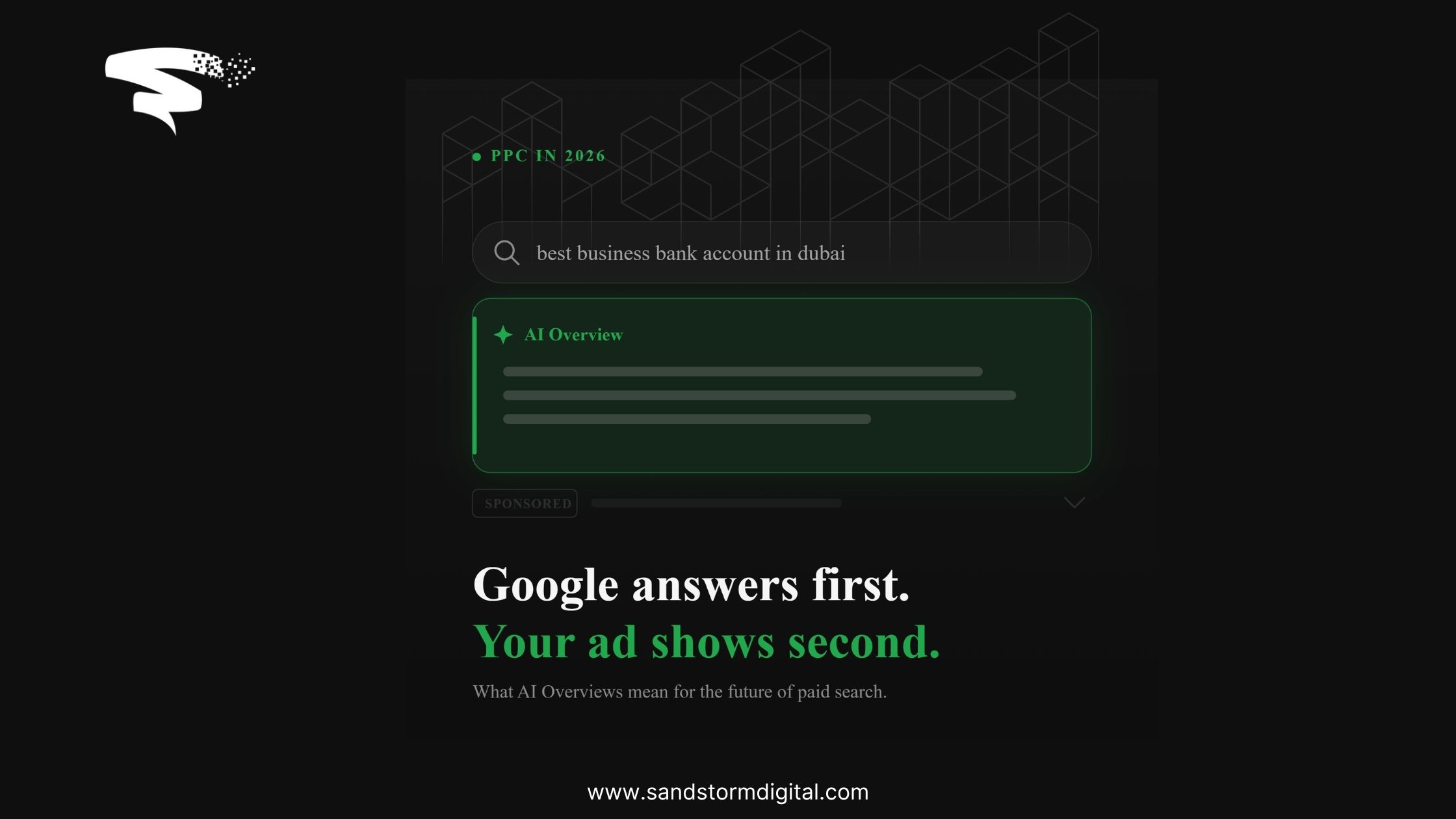
For twenty years, paid search ran on a clean promise. Someone typed a query, an auction decided who showed up, and the winner got the click. Your job was to pick the right keywords, set the right bids, and write the tightest ad. Master those three things and you had a real shot at the top of the page.
That page has changed. Google now reads the query, works out what the person actually means, and writes an answer at the very top before the traditional ads and links get their turn. The most valuable space on the results page is no longer for sale to the highest bidder. It belongs to the AI.
This is the shift every performance marketer needs to understand right now, because it quietly rewrites all three of those old fundamentals at once.
What actually changed
Two things are worth separating.
AI Overviews are the AI-generated answer boxes now sitting at the top of results for a growing share of searches. Instead of ten blue links, Google’s model reads across many sources, synthesizes a response, and hands the user the answer directly. For informational queries, the person often gets what they came for without clicking anything at all.
AI Mode goes further. It is a full conversational search experience, powered by Gemini, where people ask long, layered questions and get generated comparisons, shortlists, and follow-ups, all inside the results page. Think less “search box” and more “chat that happens to be Google.”
The important part for advertisers: ads are moving inside these experiences, not just around them. At its 2026 marketing conference, Google introduced a new generation of ad formats built specifically to live in the AI conversation rather than sit beside it.
The new formats, in plain terms
Three are worth knowing.
Conversational Discovery ads use Gemini to build the ad in real time for each individual query. Rather than serving one pre-made banner to everyone, the system writes creative that responds to what the person actually asked, paired with a separate AI-written explainer of why the product fits their situation. Both carry a clear “Sponsored” label.
Highlighted Answers work differently. When AI Mode returns a list-style response, say, a shortlist of recommended tools or apps, an eligible ad can appear inside that list as a sponsored entry. Your product becomes one of the recommendations, not an interruption before them.
AI-powered Shopping ads bring the same logic to product discovery, surfacing your items as contextual suggestions inside the AI’s answer as someone researches a purchase.
Notice the common thread. In all three, the ad is trying to be a genuinely useful part of the answer. The old game of writing a clever headline to win a click is being replaced by a new one: giving the AI such strong material that it chooses to feature you.
What you can no longer control
Here is the uncomfortable part for anyone who likes their hands on the dials.
You cannot buy an AI Overview placement directly. There is no “AI Overview campaign” to switch on. Your existing Search, Shopping, and Performance Max campaigns can already be eligible, and you cannot simply opt in or opt out of appearing.
You cannot rely on keywords the way you used to. Google’s own ads leadership put it bluntly this year, telling marketers they can no longer choose keywords. To show up in these AI experiences, campaigns increasingly need to run through AI Max for Search or Performance Max with text customization turned on, systems that interpret intent rather than match exact phrases.
And you cannot ignore the calendar. Dynamic Search Ads are set to migrate automatically to AI Max in September 2026. That is not a suggestion to consider. It is a deadline to plan around.
The theme is consistent: control is shifting from the advertiser to the system. Whether your ad appears now depends less on your bid and more on how relevant your product, feed, and landing page are to what the AI is trying to answer. If the information the model needs is not on your page, more budget will not force you in.
Why your dashboards are about to lie to you
The measurement story is subtle, and it catches a lot of good marketers off guard.
When an AI Overview answers a question at the top of the page, informational clicks fall. That is not necessarily a failure. It often means the low-value traffic that was never going to convert is being filtered out before it ever reaches you. But your click-through rate will drop, and if that number is your north star, you will read a healthy change as a problem.
Impression share gets slippery too. You can technically be in position one and still sit below a long AI answer that soaks up most of the attention. The impression counts. The visibility does not. And because placement reporting inside these AI experiences is not neatly broken out, click-through rate on its own cannot tell you whether the new surface is helping or hurting.
The takeaway is not to panic about softer top-line metrics. It is to move your judgment downstream, to leads that actually qualify and purchases that actually happen, and to stop treating clicks as the goal.
What to do about it
The platform is automating the execution layer. That does not make the marketer redundant. It moves the skill to a different place. Five shifts matter most.
Feed your product data like it is your ad copy, because now it is. When Gemini decides whether to feature you, it leans on your attributes, pricing, and descriptions. Rich, accurate, complete product data has a more direct impact on performance than it did a year ago.
Get good at briefing, not just writing. When the system generates creative per query, the valuable skill is no longer producing every headline yourself. It is defining the facts, offers, and boundaries the AI works from, so it represents you well and never oversteps. Learning what inputs produce good outputs is becoming a core competency.
Build landing pages that answer, not just convert. If your page does not contain the information the AI is looking for, your ad can be left out no matter what you spend. Pages that clearly state what you do, for whom, and why you are the right fit give the system what it needs to choose you.
Track real outcomes and feed them back. Point your campaigns at qualified leads and genuine purchases through proper conversion tracking, not raw form fills or clicks. The system optimizes toward whatever you tell it a win looks like, so define the win honestly and give it clean data.
Invest in brand authority. As answers get synthesized from across the web, brands with real reputation and consistent presence tend to surface more often. Paid and organic strength now reinforce each other. Your standing off the results page increasingly shapes your visibility on it.
The bigger shift
Strip away the format names and one change sits underneath all of it. The job of the paid search professional is moving from control to guidance.
The old craft was forcing the platform to do exactly what you said, keyword by keyword, bid by bid. The new craft is pointing an intelligent system in the right direction with inputs sharp enough that it reaches the right people on its own, then keeping a firm hand on strategy, quality, and the guardrails the AI is not allowed to cross.
Google answering the query first is not the end of paid search. It is the end of a particular way of doing it. The advertisers who adapt early, treating their data, their pages, and their briefs as the real levers, will compound an advantage while everyone else waits for a settings toggle that is not coming.
Sandstorm Digital builds AI-forward paid media and search strategies for brands navigating the shift to AI-driven search. If you want your campaigns ready for the answer-first era, let’s talk.