I have been in search long enough to remember when position one on a results page felt like an unassailable advantage. Then came featured snippets. Then AI Overviews. Each time, the industry adapted. But what Google announced at I/O 2026 is different in kind, not just degree. The architecture of search itself is changing, and the window to get ahead of it is narrower than most SEO teams realise.
Here is my read on the announcements that matter most for organic search strategy, and what we are already doing about them at Sandstorm Digital.
Google Search Is Now AI Search. Full Stop.
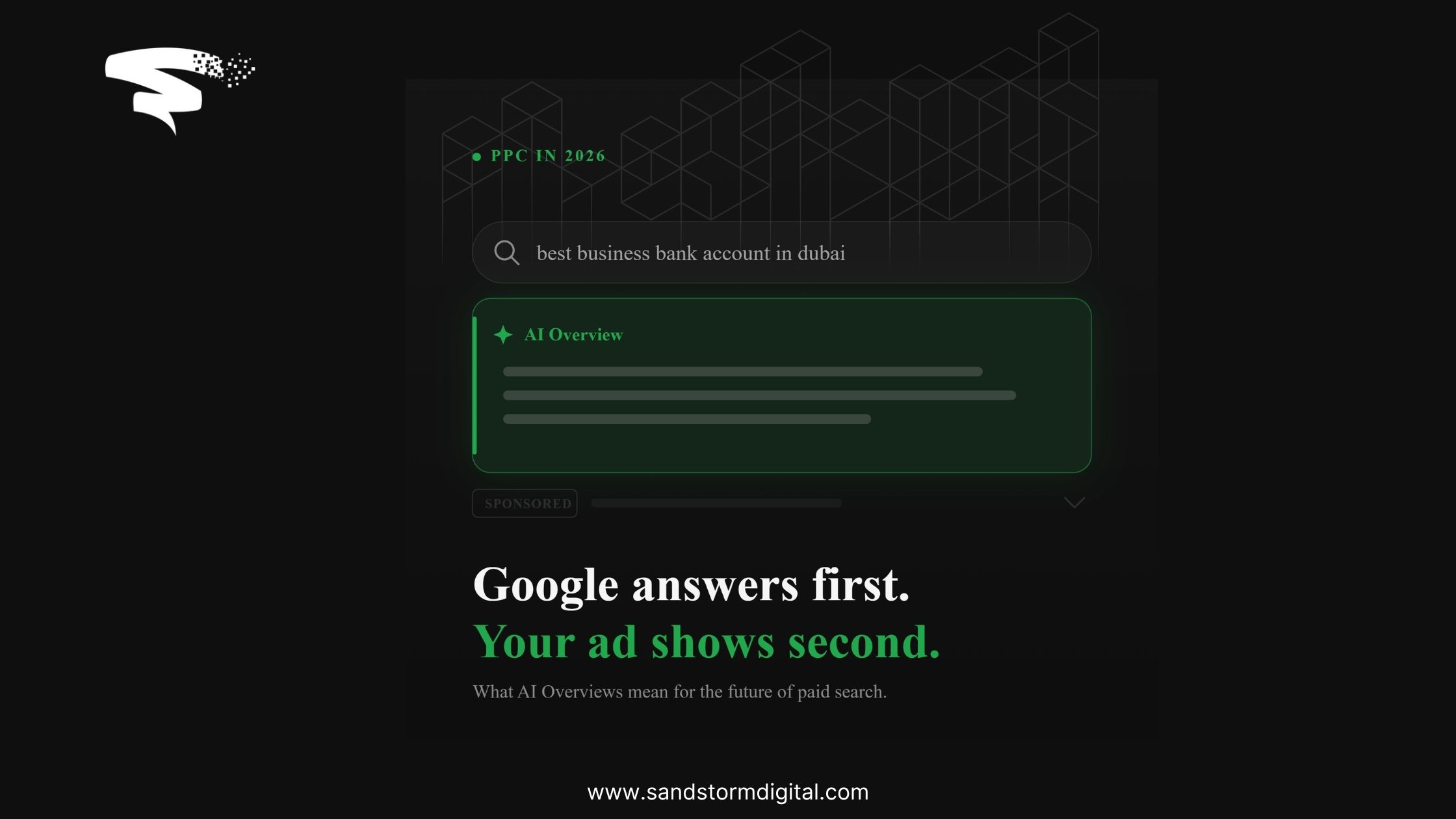
The clearest signal from I/O 2026 was not a feature announcement. It was a positioning statement: Google Search is AI Search. AI Overviews and AI Mode are being merged into a single unified experience. The search box has been redesigned for the first time in over 25 years, now accepting images, files, videos, and Chrome tabs as query inputs alongside text.
Sundar Pichai described this as the biggest upgrade to the search box in over 25 years. That framing matters. Google is not adding AI to search. Google is replacing the traditional search interface with an AI-native one. For SEO practitioners, the mental model of optimising for a ranked list of links is becoming structurally obsolete.
When the interface changes, the optimisation strategy must change with it. The question is no longer just ‘can Google crawl and rank this page?’ It is ‘will Google’s AI surface this content when a user, or an agent acting on their behalf, asks a relevant question?’
Generative UI in Search: The New SERP Nobody Is Talking About
Buried in the search announcements was something that should be front of mind for every SEO team: generative UI in Search. Using the agentic coding capabilities of Gemini 3.5 Flash and the Google Antigravity platform, Search can now build custom response layouts on the fly. We are talking about interactive visuals, simulations, tables, and dynamic components assembled in real time, tailored to the specific query.
These generative UI capabilities will be available to all users in Search this summer, free of charge. That is not a beta. That is a mainstream deployment timeline.
What this means in practice is that for complex, high-intent queries, the results page may no longer look like a results page at all. It may look like a custom tool built for that specific question. If your content is not structured in a way that feeds cleanly into this kind of AI-assembled response, your visibility in these moments will be limited regardless of your traditional ranking signals.
Information Agents: SEO for a Zero-Click-Before-the-Click World
Information Agents in Search are personalised AI agents that users can configure to run continuously in the background, surfacing relevant content, monitoring topics, and taking action on a user’s behalf. They are rolling out this summer, starting with Google AI Pro and Ultra subscribers.
Think about what this means for the top of the funnel. A user does not need to search for your content at the moment they encounter a question. An Information Agent may have already surfaced competing answers hours earlier. The discovery moment for your content may happen when the user is not even looking at a screen.
This is not the death of organic search. But it does mean that traditional SEO metrics like impressions and clicks will increasingly undercount actual AI-driven content exposure. We need new frameworks for understanding how content performs in an agent-mediated world.
What actually gets surfaced by Information Agents?
Based on what Google has disclosed, these agents use Gemini 3.5 and are designed to deliver personalised, contextually relevant content. The signals that matter are the same signals that have always made content authoritative: clear structure, genuine expertise, consistent publishing, and schema that communicates what your content is about at a machine-readable level. What changes is the weight and timing of those signals.
Gemini Omni and the Video Content Equation
Google introduced Gemini Omni at I/O, a multimodal model that generates, edits, and transforms video from virtually any input type. Text, images, audio, and existing video clips can all serve as source material. All Omni-generated content will carry SynthID watermarks.
For SEO teams, Gemini Omni matters because it accelerates the volume and variety of video content on the internet. YouTube’s Ask YouTube feature, also announced at I/O, allows users to query video content conversationally, with Gemini powering the responses. Your video content strategy is now also a discoverability strategy for AI-mediated video search.
If your brand is not producing structured, searchable video content, you are missing an increasingly significant surface area for AI-driven organic visibility.
SynthID and Content Credentials: The Coming Transparency Layer
SynthID has now marked over 100 billion pieces of AI-generated content. C2PA Content Credentials verification is rolling out in Search and Chrome over the coming months, with major partners including NVIDIA, OpenAI, and Kakao participating. Users will be able to verify the provenance of content they encounter across Google surfaces.
For SEO, this introduces a new dimension of content quality signalling. Google has long rewarded E-E-A-T: Experience, Expertise, Authoritativeness, and Trustworthiness. Content Credentials operationalise a new layer of trust verification. Brands producing AI-assisted content that is clearly attributed, properly structured, and demonstrably authored will be better positioned than those relying on anonymous, unattributed AI output.
At Sandstorm Digital, we have been advising clients to treat AI content disclosure not as a liability but as a differentiator. I/O 2026 confirms that direction.
The SEO Opportunity in an Agentic Search World
Several of the features announced at I/O are US-first at launch. Information Agents, Gemini Spark, and the generative UI in Search are all rolling out domestically before reaching international markets. For GCC brands, this is a window.
The brands and agencies that build for agentic discoverability now, before these features reach mainstream adoption in the region, will hold structural advantages when the rollout happens. That means investing in content architecture, schema implementation, and AI-legible content structures today rather than retrofitting them under pressure.
Arabic-language AI discoverability adds another layer. Google’s multilingual AI capabilities are improving rapidly, but the Arabic web remains significantly underoptimised for the kind of structured, entity-rich content that AI systems surface confidently. Brands that address this gap proactively will benefit disproportionately when AI-native search reaches full deployment across the region.
What Our SEO Team Is Doing Right Now
- Auditing content architecture for AI-legibility. Are headings, entities, and structured data communicating meaning clearly to a machine reading context, not just a human scanning a page?
- Building generative UI-ready content formats. Long-form, structured content that can be assembled into dynamic response layouts has a different profile than traditional blog posts. We are developing templates that serve both.
- Developing an Arabic AI discoverability framework for GCC clients, combining entity optimisation, schema implementation, and Arabic-first content structures designed for AI-mediated search surfaces.
- Revising E-E-A-T guidance in light of Content Credentials. Attribution, authorship signals, and transparent AI use are becoming technical SEO considerations, not just editorial ones.
The core principle of SEO has not changed: be genuinely useful, be clearly structured, be trustworthy. What Google I/O 2026 confirms is that the systems evaluating those qualities are now far more sophisticated, and far more autonomous, than they were twelve months ago.