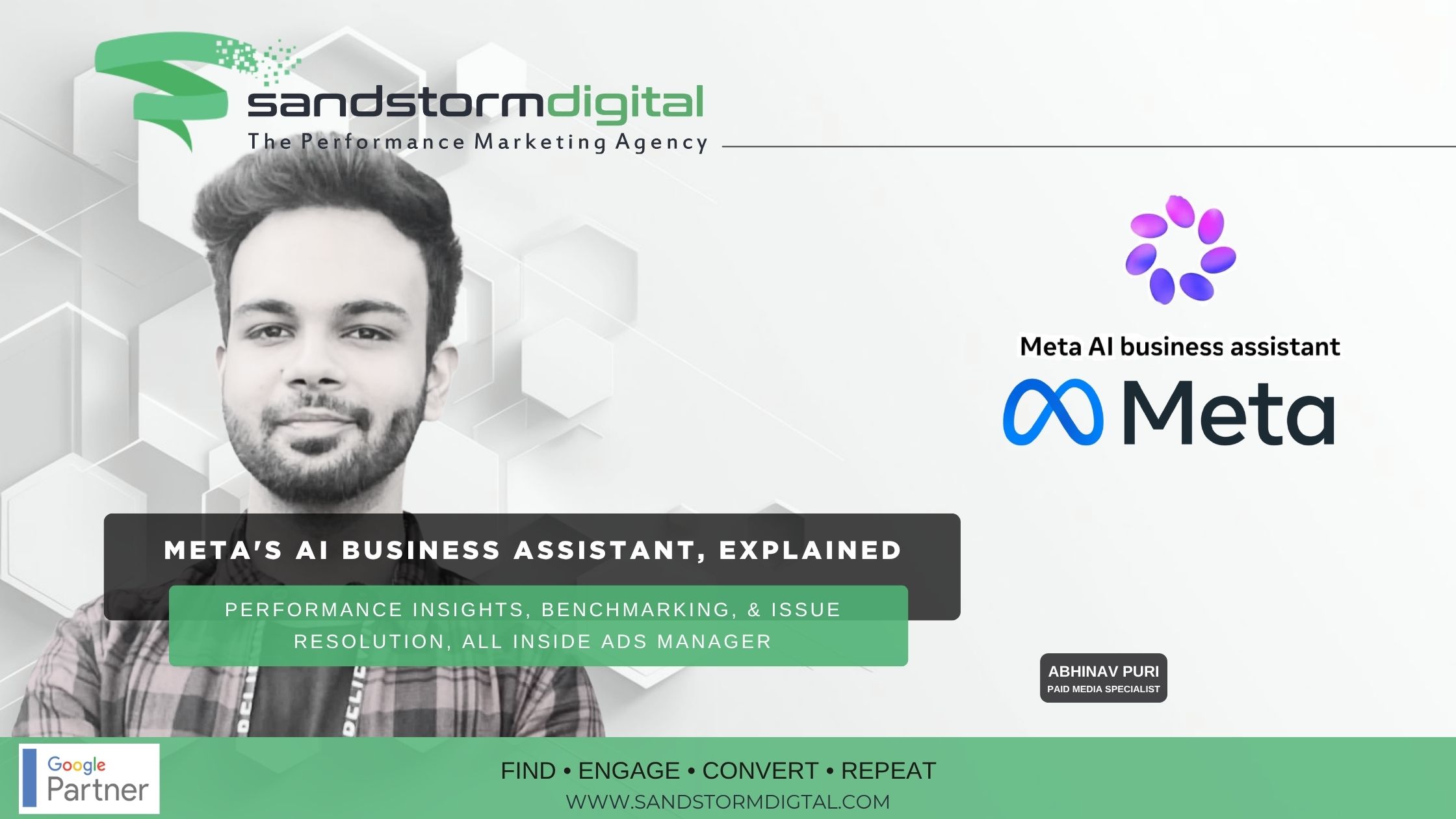
Meta held a live virtual panel bringing together product experts and business leaders to walk through what their AI-powered ad tools can do right now. Here is a breakdown of the key things covered, and what it means if you are running paid social in the GCC or anywhere else.
The Assistant Is Now Available Globally
As of April 2026, Meta has rolled out its AI Business Assistant to all advertisers globally, across the US, EMEA, Asia-Pacific, and Latin America. It lives directly inside Ads Manager and Meta Business Suite, at no extra cost. Advertising and agency partners can access it within Meta Ads Manager, Meta Business Suite, and Business Support Home.
Meta is currently offering these business AI tools for free to help smaller businesses achieve scale, though CEO Mark Zuckerberg has hinted that a longer-term monetization model is likely on the horizon.
What It Actually Does
The assistant is not a general chatbot. It is built around your ad account data specifically, and its value comes from three core functions.
Performance insights on demand
Instead of manually digging through Ads Manager, you can ask the assistant to surface trends, generate charts, and identify what is working or underperforming across your campaigns. It pulls from your current and historical data, so the output is specific to your account, not generic advice.
Industry benchmarking
This is one of the more practically useful features. The assistant benchmarks your CPR, CTR, and ROAS against an aggregated cohort of advertisers with similar characteristics, including spend level, optimization goal, and advertiser vertical. If your strategy shifts, the benchmark cohort adjusts automatically, so the comparison stays relevant.
Opportunity Score recommendations
The assistant surfaces Opportunity Score suggestions with detailed reasoning, not just a number. The headline stat Meta is citing is a 12% median decrease in cost per result for small business advertisers who applied Opportunity Score recommendations. That is not a guarantee, but it is a directionally meaningful data point.
Issue resolution
This one is underrated. You can describe an account issue in plain language and the assistant will work to resolve it: restricted accounts, spend limit increases, delivery errors. The tool targets a 20% improvement in issue resolution rates, and for small businesses this is particularly useful since it reduces dependence on Meta support queues.
Where It Fits in Your Workflow
The assistant is most effective when you have at least four to six weeks of campaign history. Without historical data, the benchmarking and performance analysis features have limited value. It is also worth being clear about what it does not replace: campaign strategy, creative direction, budget decisions, and conversion tracking setup all still require human judgment. The assistant recommends, you decide.
Throughout 2026, Meta has indicated it plans to expand capabilities into campaign planning and creation. That would represent a significant jump in scope from where the tool sits today.
What This Means for Performance Marketers
The practical shift here is speed. Insights that previously required manual reporting or an analyst pulling data can now surface in seconds. For agencies managing multiple clients or for in-house teams without deep data resources, that compression of time is real. The benchmarking feature is also worth paying attention to, particularly for clients in competitive verticals who want a reference point beyond their own historical performance.
Meta’s business AI is now handling 10 million conversations per week, which gives a sense of how fast adoption is moving. The tool is still in beta and being refined, but the trajectory is clear: AI is becoming the interface layer between advertisers and their ad accounts.
If you are running Meta campaigns and have not explored the assistant yet, it is worth a look, especially before the feature set expands and the learning curve grows with it.