
Google dropped something significant last week: an official guide for optimizing your website for generative AI features on Google Search. AI Overviews, AI Mode, and whatever comes next. This is Google putting its cards on the table and telling the SEO world exactly what it cares about.
We read it so you don’t have to. Here’s the honest breakdown.
First: Is SEO Dead (Again)?
No. Stop asking.
Google is very clear on this. Their generative AI features are built on top of the same core ranking and quality systems that have always powered Search. The AI is not operating in some parallel universe with different rules. It is pulling from the Search index, using retrieval-augmented generation (RAG) to ground its responses in real, crawlable web pages, and applying the same quality signals it always has.
So if you have been doing solid SEO work, you are already most of the way there. That is not a consolation prize. That is the actual answer.
The One Thing That Matters More Than Everything Else
Google says it plainly: create content that is unique, compelling, and useful, and it will likely influence your visibility in generative AI search more than any other tactic.
They even give you a useful frame to test your content against. The difference between commodity content and non-commodity content.
Commodity content is “7 Tips for First-Time Homebuyers.” It is generic. It could have been written by anyone, or frankly, by a chatbot in 30 seconds. It adds nothing new to the conversation.
Non-commodity content is something like “Why We Waived the Inspection and Saved Money: A Look Inside the Sewer Line.” That is specific. That is experience. That is the kind of thing an AI system looks for when it is trying to give a user a genuinely useful answer, not just a competent-sounding one.
The question to ask yourself before publishing anything: Is this content my visitors would find satisfying? If the honest answer is no, do not publish it.
The Technical Stuff Still Matters (But Not More Than It Did)
Google is not asking you to do anything new on the technical side. The checklist looks familiar: your pages need to be indexed and crawlable, your site needs to render properly including JavaScript, duplicate content should be kept in check, and page experience signals like speed and mobile display still count.
One thing worth calling out: semantic HTML. Google specifically mentions it helps AI agents and accessibility tools navigate your content. It does not have to be perfect (the web is not valid HTML and never has been), but it is worth caring about.
Search Console remains your best diagnostic tool. If you are not verified, fix that first.
For Ecommerce and Local Businesses: Do Not Skip This
Google explicitly flags that generative AI responses can include product listings and local business information. If you are running ecommerce or a service business, Merchant Center feeds and Google Business Profile are now AI discoverability tools, not just nice-to-haves. Products that live in your Merchant Center feed have a path into AI-generated answers. Products that do not, do not.
There is also a mention of something called Business Agent, a conversational experience that lets customers chat with your brand directly in Search. Worth keeping an eye on as this matures.
The Myth-Busting Section Is the Most Valuable Part of the Guide
This is where Google earns real respect. They directly call out tactics that have been circulating in the industry as either unnecessary or outright useless for Google Search specifically.
llms.txt files. Do not bother creating one for Google Search ranking purposes. Google may crawl it. It does not treat it as special. The file has value in other contexts (some AI tools and crawlers do reference it), but for Google AI Overviews and AI Mode, it changes nothing.
Content chunking. There is no requirement to break your content into small chunks so AI can understand it better. Google’s systems can handle nuanced, multi-topic pages. Write for your audience, not for a hypothetical AI chunk parser.
Rewriting content to match AI phrasing. You do not need to stuff in long-tail keyword variations or write in a particular way because you think AI systems prefer it. Google’s AI understands synonyms and intent. Write like a human expert.
Buying or engineering inauthentic mentions. This one is important. There is a growing cottage industry around getting your brand mentioned across blogs, forums, and other sites to appear more prominent in AI responses. Google calls this out directly. Their spam systems catch it. Their quality systems discount it. It is the link scheme problem, restaged for the AI era.
Over-investing in structured data for AI. Structured data is still worth using for rich results. But Google is clear: there is no special schema markup that gets you into AI Overviews. Do not let anyone sell you on a proprietary schema strategy for AI visibility.
The Agentic Search Section Is a Preview of What Is Coming
This is the part of the guide that is furthest from current reality but closest to what everyone should be thinking about.
AI agents can visit your website, take screenshots, read your DOM, interpret your accessibility tree, and complete tasks on behalf of users. Think booking a reservation. Comparing product specs. Submitting a form. These are not search behaviors. These are interaction behaviors. And they are already happening in early form.
Google points to a separate guide on agent-friendly website best practices and mentions the Universal Commerce Protocol (UCP) as an emerging standard for agent-based commerce interactions.
If your website is a mess to navigate for humans, it will be a mess for agents too. Accessible, clean, well-structured sites have a real advantage here as this layer of AI interaction develops.
What This Means for Your Strategy
Pull back the complexity and you get a clean picture of what Google is telling you to do:
The brands that will win in AI search are the ones with genuine expertise, clean sites, and content that actually earns trust. Not the ones with the cleverest technical workarounds or the newest AI file format.
The rules did not change. The stakes just got higher.
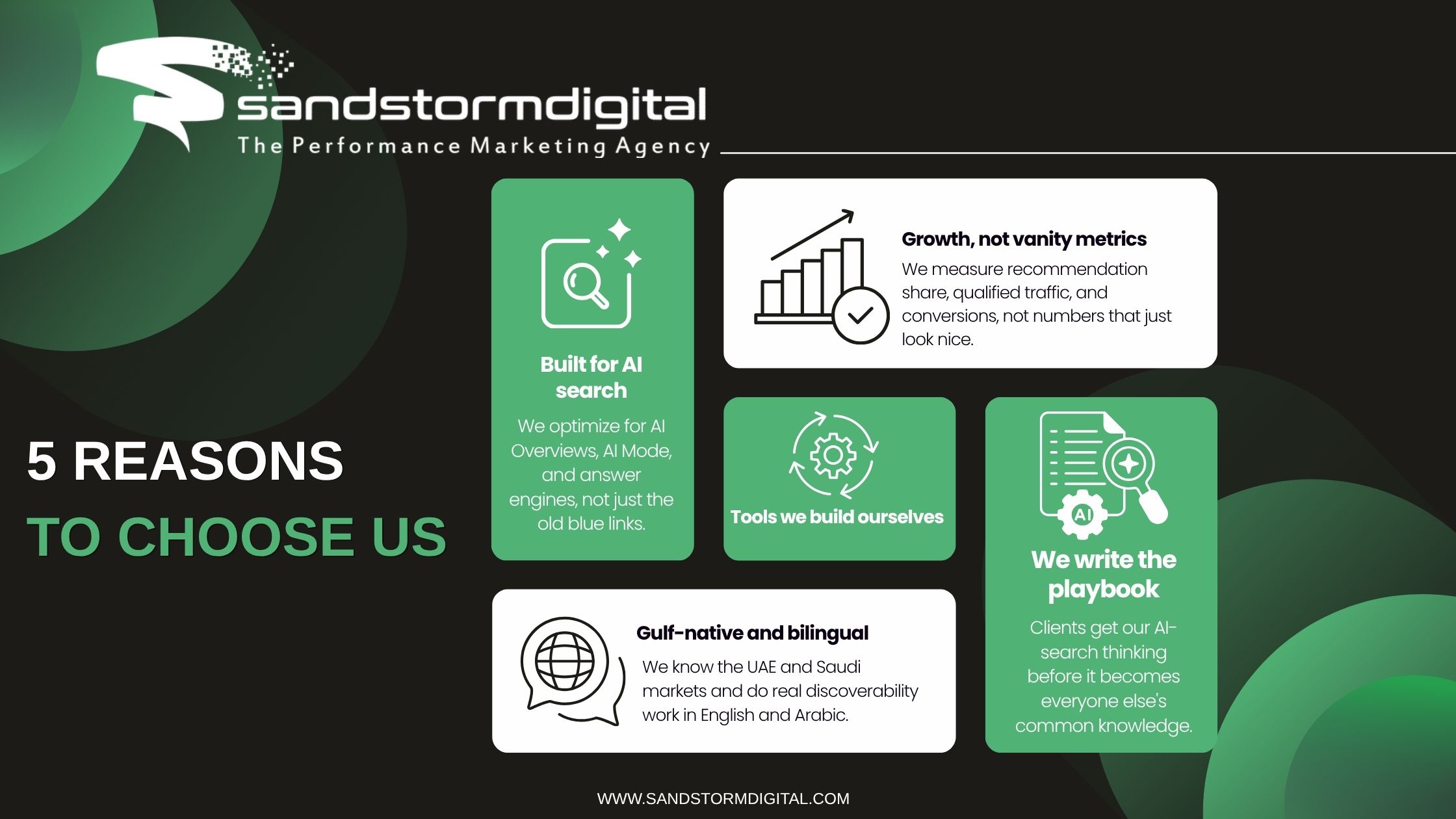
If you want to pressure-test how your content and technical setup perform in AI search environments, that is exactly the kind of work we do at Sandstorm Digital. Get in touch.