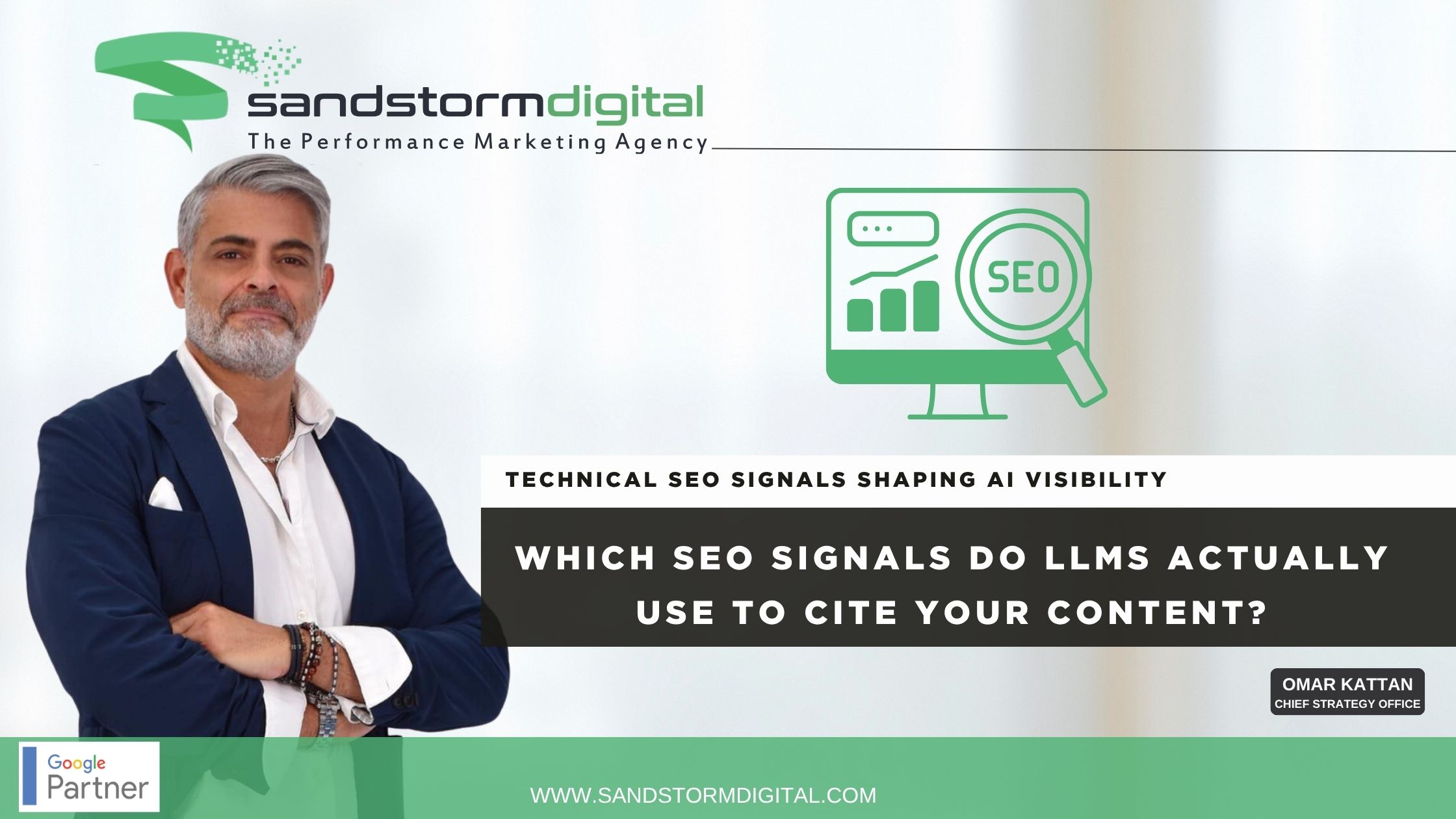
Which SEO Signals Do LLMs Actually Use to Cite Your Content?
Sandstorm Digital | May 2026 | 8 min read
Search is no longer a single-engine question. Large language models now compete for answer real estate that traditional rankings once owned. Understanding the signals they prioritise, and how to make your site technically accessible to them, is no longer optional for performance marketers.
The shift from ranking to citation
Traditional search engines index pages and surface links. LLMs surface answers and cite sources. That distinction changes everything about what “visibility” means. When a marketing director asks ChatGPT or Perplexity to compare enterprise SEO agencies in the GCC, your brand either appears in the generated answer or it does not. There is no page two.
What determines whether an LLM cites your content comes down to a cluster of signals that overlap with classical SEO but diverge in important ways. Brand authority, semantic depth, structured accessibility, and technical crawlability all feed into the equation.
The primary signals LLMs rely on
Brand search volume is the strongest predictor of AI citations. Unlinked brand mentions across the web register as trust signals for LLMs.
LLMs reward content that demonstrates expertise across a topic cluster, not isolated pages optimised for single keywords.
Quality still outweighs volume. A citation from a respected publication carries more weight than dozens of mid-tier links.
LLMs actively prefer recent content. Pages with outdated publish dates lose citation priority even when the information remains accurate.
Structured data helps LLMs parse and surface your content correctly. Article, FAQ, and Organization schema are the highest-leverage implementations.
Slow load times, broken canonicals, and misconfigured schema create friction that prevents both crawlers and LLMs from trusting your pages.
Brand authority now outranks links
Research into LLM citation behaviour consistently surfaces one finding that surprises marketing directors: brand search volume is the strongest single predictor of whether an LLM will cite a source. This means brand-building activities that once seemed disconnected from SEO, such as PR coverage, executive thought leadership, and consistent social presence, now have a direct and measurable impact on AI visibility.
LLMs are trained on data that rewards entities discussed repeatedly across credible sources. A brand mentioned in industry publications, referenced in community forums like Reddit, and searched by name on Google signals trustworthiness to the model at training time. Unlinked mentions carry weight here in a way they never did in classical link graph analysis.
GEO note for the GCC market: Arabic content discoverability operates with a smaller pool of high-authority publishers. This concentrates the importance of the sources where your brand appears. A single placement in a respected Arabic-language business outlet may carry more signal weight than five mid-tier English placements.
Semantic depth over keyword density
Unlike traditional search engines that prioritise keyword match, LLMs process meaning through context windows. They assess whether your content demonstrates genuine expertise across a topic, not just whether a target phrase appears at the right density. Technical terminology, treated as a signal of authority by LLMs, should be present where it belongs rather than avoided for fear of jargon.
Topic clusters matter more here than individual pages. A site that covers performance marketing comprehensively, from PPC attribution to AI-driven ecommerce search, signals to a model that the publisher has domain authority. Siloed pages optimised for isolated queries do not produce the same effect.
Technical accessibility: robots.txt and AI crawlers
No SEO or AEO strategy works if pages cannot be accessed by the crawlers that feed LLM systems. This is where robots.txt becomes a material business decision, not just a technical configuration.
The AI crawler landscape
Each major AI platform operates its own bot infrastructure. Understanding which bots do what determines how you configure access.
| User-agent | Platform | Type | Impact on visibility |
|---|---|---|---|
GPTBot |
OpenAI | Training | Influences model training data; not directly tied to search answers |
OAI-SearchBot |
OpenAI | Search | Blocking this prevents your site appearing in ChatGPT search answers |
ChatGPT-User |
OpenAI | Retrieval | User-triggered page fetches when ChatGPT browses the web |
ClaudeBot |
Anthropic | Training | Feeds Claude model training; currently blocked by 69% of sites |
Claude-SearchBot |
Anthropic | Search | Affects Claude’s search-answer sourcing; equivalent to OAI-SearchBot |
PerplexityBot |
Perplexity | Search | Determines citation eligibility in Perplexity-generated answers |
Google-Extended |
Training | Controls content use in Gemini and Vertex AI systems |
Key distinction: Training bots and search bots serve different functions. A strategically configured robots.txt can block training crawlers while explicitly allowing search crawlers, so your content is cited in AI-generated answers without contributing to model training pipelines where you prefer not to.
How to configure robots.txt for AI visibility
The most common and costly mistake is a legacy robots.txt that only addresses Googlebot and Bingbot. A wildcard Disallow: / under User-agent: * will silently block all AI crawlers by default. Auditing this file is the first step of any AEO engagement.
Below is a reference configuration that maximises AI search visibility while retaining granular control over training access.
# robots.txt: AI-optimised configuration for maximum GEO/AEO visibility

# Allow all crawlers baseline access
User-agent: *
Allow: /

# OpenAI: allow search bot, manage training separately
User-agent: OAI-SearchBot
Allow: /

User-agent: ChatGPT-User
Allow: /

User-agent: GPTBot
Allow: /

# Anthropic: all three bots explicitly addressed
User-agent: ClaudeBot
Allow: /

User-agent: Claude-SearchBot
Allow: /

User-agent: Claude-Web
Allow: /

# Perplexity
User-agent: PerplexityBot
Allow: /

# Google AI systems
User-agent: Google-Extended
Allow: /

# Sitemap
Sitemap: https://yourdomain.com/sitemap.xml
robots.txt compliance is advisory, not enforced
One critical nuance marketing directors need to understand: robots.txt operates on the honour system. Research indicates that up to 72% of AI crawlers have been found to violate robots.txt directives, with an average of 156 violation requests per site recorded across a three-week audit window in 2025. This means your robots.txt configuration is a necessary first layer but should not be treated as a complete content access policy.
Complementary measures, including server-side rate limiting, CDN-level bot management, and monitoring of server logs for user-agent patterns, provide additional control. For brands with proprietary methodology or content assets, these layers become essential rather than optional.
The separate question of llms.txt
The proposed llms.txt standard, which operates similarly to robots.txt but targets AI training consent, has attracted attention since 2024. Current evidence suggests that major AI crawlers do not actively read the file. Robots.txt remains the only widely respected crawl control mechanism as of mid-2026. That said, implementing llms.txt is a low-cost action that positions a site ahead of the standard as adoption grows among AI labs.
Signals that differ from classical SEO
Several properties matter more in LLM environments than in traditional search, and understanding these gaps helps marketing directors prioritise budget allocation correctly.
Content comprehensiveness outperforms content brevity. LLMs favour pages that provide thorough, well-structured answers rather than short pages optimised for featured snippets. Internal linking that creates clear topical relationships across a domain is rewarded because it mirrors the way LLMs evaluate subject-matter coherence.
Social platform presence is increasingly a signal. Educational content on X that breaks down processes, structured YouTube video descriptions, and Instagram posts with substantive captions and alt text are all being indexed by AI systems. Platforms with parseable, searchable language create additional surface area for LLM citation.
- Run a robots.txt audit to confirm AI search bots are not blocked
- Identify whether training bots and search bots are configured separately
- Review schema markup coverage across service and blog pages
- Assess content freshness across top-performing pages and establish a review cadence
- Map brand mention presence across third-party publications in your target markets
- Evaluate topic cluster coverage against primary service areas
- Monitor server logs monthly to track AI crawler activity and detect violations
The brands that establish AI citation authority early will be significantly harder to displace. In competitive GCC markets where AI-generated answers increasingly shape the consideration phase of a buyer journey, this is not a future concern. It is a present one.
Sandstorm Digital assesses technical crawlability, schema coverage, and citation signal strength across ChatGPT, Perplexity, Claude, and Google AI Overviews.