
For the last two years, the conversation around AI visibility has been a discovery problem. Brands wanted to show up in ChatGPT responses, get cited in Perplexity, and appear in Google’s AI Overviews. The goal was to be mentioned. To be found.
That was phase one.
Phase two is already underway, and the stakes are higher. AI agents, tools like OpenAI’s Operator, Google’s Project Mariner, and Perplexity’s shopping assistant, are no longer just recommending products. They are completing purchases on behalf of users. They browse, compare, add to cart, and check out. The user may not even open a browser.
This changes everything about what it means to be visible online.
The question for ecommerce brands is no longer only “can AI find me?” It is “can AI buy from me?” If your site is not built to support agentic transactions, you will not just lose rankings. You will lose sales at the moment of intent, to competitors whose infrastructure is agent-ready.
Here is what is happening, why it matters, and what your ecommerce team needs to do about it.
From Discovery to Action: What AI Agents Actually Do
An AI agent is not a search engine. It is a task executor. When a user tells OpenAI’s Operator “order me a pair of trail running shoes under AED 400,” the agent does not return a list of links. It visits product pages, reads specifications, compares options, and initiates the purchase.
This is a fundamentally different type of site visit. There is no browsing session. There is no emotional engagement with your homepage photography. There is no window shopping. The agent arrives with a brief, evaluates whether your product and site meet its requirements, and either transacts or moves on.
Several of these agents are already live and being used by consumers today:
- OpenAI Operator: a browser-use agent that can fill forms, click through checkout flows, and complete purchases across standard ecommerce sites
- Perplexity Shopping: a discovery and transaction layer that pulls structured product data and enables one-click purchasing from within the Perplexity interface
- Google Project Mariner: Google’s browser agent, currently in research preview, designed to navigate and transact on behalf of users
- Anthropic Claude with computer use: capable of navigating browser-based interfaces to execute multi-step tasks including ecommerce flows
These are not concepts. They are tools your customers are already using. And right now, most ecommerce sites are not built to handle them well.
What an AI Agent Needs to Complete a Purchase
To understand the gap between current ecommerce infrastructure and agent-readiness, it helps to map exactly what an agent needs at each stage of the purchase journey.
1. Structured Product Data It Can Actually Read
Agents read data the way search crawlers do, but they need more of it and they need it to be precise. Schema.org Product markup is the foundation. Every product page should include:
- Name, SKU, brand, and category
- Current price and availability (updated in real time, not cached)
- Aggregate review rating and review count
- Return and shipping policy markup where available
- Variant-level data (size, colour, stock per variant) as distinct structured entries
If this data is missing, inconsistent, or buried in JavaScript that the agent cannot parse, your product will not meet the evaluation criteria. The agent will not guess. It will move to a site that gives it what it needs.
2. A Checkout Flow the Agent Can Navigate
Most ecommerce checkouts are designed for human browsing: multi-step flows, pop-up banners, login walls, CAPTCHA gates, and session-dependent cart logic. Agents struggle with all of these.
The key friction points to address:
- Guest checkout must be a clear, uninterrupted path. If your site forces account creation or uses dark patterns to obscure guest checkout, agents will fail at this step.
- CAPTCHA and bot detection should distinguish between malicious bots and legitimate agent traffic. Shopify’s commerce APIs, for instance, offer token-based authentication that allows verified agents to transact without triggering fraud blocks.
- Forms must use semantic HTML with correct field labelling. An input field for “email” that is only identifiable visually (not by name or label attributes) cannot be reliably filled by an agent.
- Payment flows that rely on redirect-heavy third-party processors or non-standard iframe implementations can break agent journeys mid-checkout.
Shopify merchants are ahead here. Shopify has been actively building agent-compatible commerce infrastructure, including its Storefront API and Buy SDK, which are already used by agentic integrations. If you are on a legacy or heavily customised platform, this is worth auditing now.
3. Trust and Confidence Signals
Before an agent transacts, it needs confidence that the merchant is legitimate and the product data is accurate. This is the trust layer. It includes:
- Price consistency across your site, Google Shopping, and any feeds you push to third-party platforms. Agents will flag discrepancies.
- Review data that is indexable. Reviews locked inside JavaScript widgets or loaded via non-standard plugins may not be visible to agents. Structured review markup in JSON-LD is the safest approach.
- Return and refund policies written in plain language and marked up with schema where possible. Policies buried in PDF documents or accessible only through modal pop-ups are effectively invisible to agents.
- Clear merchant identity signals: About pages, contact information, business registration details, and HTTPS security are basic requirements that agents use as trust indicators.
4. API Access and Agent-Specific Protocols
The most forward-looking brands are not waiting for agents to scrape their product pages. They are publishing structured data feeds and opening headless commerce APIs that agents can query directly.
One emerging standard worth watching is llms.txt, a protocol (modelled on robots.txt) that allows sites to communicate directly with AI models and agents about what data is available and how it should be accessed. It is early, but adoption is growing among sites that are positioning themselves as AI-native.
For larger ecommerce operations, investing in a headless commerce layer with documented APIs is the most durable infrastructure play. It future-proofs you against whatever the next generation of agent protocols looks like.
Agent-Ready vs. Agent-Hostile: Where Most Sites Stand Today
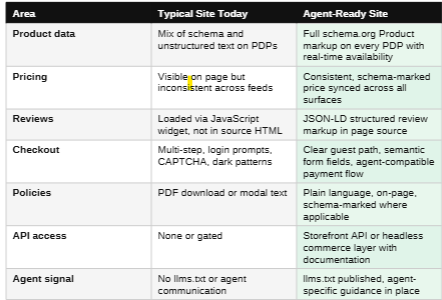
Most ecommerce sites were built for human browsing, not machine execution. That is not a criticism. It is simply a reflection of how the industry evolved. But the gap between where most sites are and where agent-ready infrastructure sits is significant. Here is a direct comparison:
For the last two years, the conversation around AI visibility has been a discovery problem. Brands wanted to show up in ChatGPT responses, get cited in Perplexity, and appear in Google’s AI Overviews. The goal was to be mentioned. To be found.
That was phase one.
Phase two is already underway, and the stakes are higher. AI agents, tools like OpenAI’s Operator, Google’s Project Mariner, and Perplexity’s shopping assistant, are no longer just recommending products. They are completing purchases on behalf of users. They browse, compare, add to cart, and check out. The user may not even open a browser.
This changes everything about what it means to be visible online.
The question for ecommerce brands is no longer only “can AI find me?” It is “can AI buy from me?” If your site is not built to support agentic transactions, you will not just lose rankings. You will lose sales at the moment of intent, to competitors whose infrastructure is agent-ready.
Here is what is happening, why it matters, and what your ecommerce team needs to do about it.
From Discovery to Action: What AI Agents Actually Do
An AI agent is not a search engine. It is a task executor. When a user tells OpenAI’s Operator “order me a pair of trail running shoes under AED 400,” the agent does not return a list of links. It visits product pages, reads specifications, compares options, and initiates the purchase.
This is a fundamentally different type of site visit. There is no browsing session. There is no emotional engagement with your homepage photography. There is no window shopping. The agent arrives with a brief, evaluates whether your product and site meet its requirements, and either transacts or moves on.
Several of these agents are already live and being used by consumers today:
- OpenAI Operator: a browser-use agent that can fill forms, click through checkout flows, and complete purchases across standard ecommerce sites
- Perplexity Shopping: a discovery and transaction layer that pulls structured product data and enables one-click purchasing from within the Perplexity interface
- Google Project Mariner: Google’s browser agent, currently in research preview, designed to navigate and transact on behalf of users
- Anthropic Claude with computer use: capable of navigating browser-based interfaces to execute multi-step tasks including ecommerce flows
These are not concepts. They are tools your customers are already using. And right now, most ecommerce sites are not built to handle them well.
What an AI Agent Needs to Complete a Purchase
To understand the gap between current ecommerce infrastructure and agent-readiness, it helps to map exactly what an agent needs at each stage of the purchase journey.
1. Structured Product Data It Can Actually Read
Agents read data the way search crawlers do, but they need more of it and they need it to be precise. Schema.org Product markup is the foundation. Every product page should include:
- Name, SKU, brand, and category
- Current price and availability (updated in real time, not cached)
- Aggregate review rating and review count
- Return and shipping policy markup where available
- Variant-level data (size, colour, stock per variant) as distinct structured entries
If this data is missing, inconsistent, or buried in JavaScript that the agent cannot parse, your product will not meet the evaluation criteria. The agent will not guess. It will move to a site that gives it what it needs.
2. A Checkout Flow the Agent Can Navigate
Most ecommerce checkouts are designed for human browsing: multi-step flows, pop-up banners, login walls, CAPTCHA gates, and session-dependent cart logic. Agents struggle with all of these.
The key friction points to address:
- Guest checkout must be a clear, uninterrupted path. If your site forces account creation or uses dark patterns to obscure guest checkout, agents will fail at this step.
- CAPTCHA and bot detection should distinguish between malicious bots and legitimate agent traffic. Shopify’s commerce APIs, for instance, offer token-based authentication that allows verified agents to transact without triggering fraud blocks.
- Forms must use semantic HTML with correct field labelling. An input field for “email” that is only identifiable visually (not by name or label attributes) cannot be reliably filled by an agent.
- Payment flows that rely on redirect-heavy third-party processors or non-standard iframe implementations can break agent journeys mid-checkout.
Shopify merchants are ahead here. Shopify has been actively building agent-compatible commerce infrastructure, including its Storefront API and Buy SDK, which are already used by agentic integrations. If you are on a legacy or heavily customised platform, this is worth auditing now.
3. Trust and Confidence Signals
Before an agent transacts, it needs confidence that the merchant is legitimate and the product data is accurate. This is the trust layer. It includes:
- Price consistency across your site, Google Shopping, and any feeds you push to third-party platforms. Agents will flag discrepancies.
- Review data that is indexable. Reviews locked inside JavaScript widgets or loaded via non-standard plugins may not be visible to agents. Structured review markup in JSON-LD is the safest approach.
- Return and refund policies written in plain language and marked up with schema where possible. Policies buried in PDF documents or accessible only through modal pop-ups are effectively invisible to agents.
- Clear merchant identity signals: About pages, contact information, business registration details, and HTTPS security are basic requirements that agents use as trust indicators.
4. API Access and Agent-Specific Protocols
The most forward-looking brands are not waiting for agents to scrape their product pages. They are publishing structured data feeds and opening headless commerce APIs that agents can query directly.
One emerging standard worth watching is llms.txt, a protocol (modelled on robots.txt) that allows sites to communicate directly with AI models and agents about what data is available and how it should be accessed. It is early, but adoption is growing among sites that are positioning themselves as AI-native.
For larger ecommerce operations, investing in a headless commerce layer with documented APIs is the most durable infrastructure play. It future-proofs you against whatever the next generation of agent protocols looks like.
Agent-Ready vs. Agent-Hostile: Where Most Sites Stand Today
Most ecommerce sites were built for human browsing, not machine execution. That is not a criticism. It is simply a reflection of how the industry evolved. But the gap between where most sites are and where agent-ready infrastructure sits is significant.
Here is a direct comparison:
The SEO and GEO Connection
It is worth being direct about how agentic readiness connects to everything you have already built around SEO and generative engine optimisation.
The signals that make you citation-eligible in ChatGPT or AI Overviews (authoritative content, structured markup, trustworthy merchant signals, clean technical infrastructure) are largely the same signals that make you transaction-eligible when an agent arrives with a purchase intent.
The difference is execution depth. GEO optimisation for discovery needs your content to be readable and trustworthy. Agentic optimisation for transaction needs your entire site infrastructure to support machine-driven action: from the product data layer through to the confirmation email.
Brands that have invested in technical SEO fundamentals (schema, crawlability, site speed, clean URL structures) are closer to agent-ready than they might think. The gap is typically in the checkout and trust layers, not in the content.
A Prioritised Action Plan for Ecommerce Teams
If you want to make your ecommerce site agent-ready, here is where to start. These are sequenced by impact and effort.
Priority 1: Schema audit and fix
Run a full schema.org audit across your product pages. Use Google’s Rich Results Test and a structured data crawler to identify gaps. Every product page needs complete Product schema with live pricing, availability, and review data. This is the single highest-impact change you can make.
Priority 2: Checkout flow audit
Walk through your checkout as a non-logged-in user. Document every friction point: login prompts, CAPTCHAs, unclear form labelling, payment redirect flows. Prioritise clearing the guest checkout path first. Then review your form field semantics with your development team.
Priority 3: Policy and trust page visibility
Move your return and shipping policies onto indexable, on-page HTML. Replace PDF downloads and modals with clean text pages that are linked from product pages and the checkout. Mark them up with schema where available.
Priority 4: Review data accessibility
If your reviews are loaded via a third-party widget that renders in JavaScript, talk to your development team about adding JSON-LD review markup to your page source. Agents cannot reliably access JavaScript-rendered content.
Priority 5: Publish an llms.txt file
This takes less than an hour and signals to agents and AI models that you have structured your site intentionally for machine access. It will not make your site agent-ready on its own, but it is a clear marker of intent and early adoption.
Priority 6: Evaluate your commerce platform’s API capabilities
If you are on Shopify, you likely already have access to the Storefront API. Understand what is available and whether your current setup exposes it to external consumers. If you are on a legacy platform, this is a longer-term infrastructure conversation worth starting now.
The Window to Act Is Now
Agentic commerce is not a 2028 problem. OpenAI Operator has been in public release since early 2025. Perplexity’s shopping features are live and actively used. Google’s agent layer is in advanced testing. The brands that build agent-ready infrastructure now will have a meaningful head start before this becomes table stakes.
The good news is that if you have been investing in technical SEO and GEO, you are not starting from zero. The foundations are largely in place. What is needed now is a deliberate audit of your checkout flow, your data layer, and your trust signals, viewed through the lens of machine execution rather than human browsing.
The brands that get this right will not just appear in AI responses. They will be the ones AI agents choose to buy from.